Working Holiday Visa (Subclass 417): Complete Guide 2026
The Working Holiday Visa (Subclass 417) lets young adults from 19 eligible countries live and work in Australia for up to 12 months, with the option to extend for a second and third year by completing specified work in regional Australia. You must be 18–30 years old (18–35 for some nationalities), and the visa costs $640 AUD. There are no annual caps — if you're eligible, you can apply anytime.
Quick Facts
| Detail | Information |
|---|---|
| Visa subclass | 417 |
| Cost | $640 AUD |
| Age limit | 18–30 (18–35 for Canadian, French, Irish, and UK citizens) |
| Stay duration | Up to 12 months (extendable to 3 years total) |
| Work rights | Full work rights; 6-month limit per employer |
| Study | Up to 4 months |
| Eligible countries | 19 |
| Annual cap | None |
| 2nd year visa | 88 days specified work in regional Australia |
| 3rd year visa | 6 months specified work on 2nd year visa |
Eligible Countries
The Subclass 417 is available to passport holders from the following 19 countries:
| Belgium | Canada | Cyprus (Republic of) |
| Denmark | Estonia | Finland |
| France | Germany | Hong Kong SAR |
| Ireland | Italy | Japan |
| Malta | Netherlands | Norway |
| South Korea | Sweden | Taiwan |
| United Kingdom |
If your country isn't listed, check the Work and Holiday Visa (Subclass 462), which covers a different set of 41 countries.
Extended Age Limit (18–35)
Most 417 applicants must be 18–30 years old when they apply. However, four nationalities benefit from an extended age limit of 18–35:
This is a bilateral arrangement — it doesn't apply to all 417-eligible countries. If you're a 33-year-old German citizen, you're unfortunately too old for the 417. But a 33-year-old Canadian can still apply.
What You Can Do on a 417
The Working Holiday Visa is one of Australia's most flexible visas. Here's what's permitted.
Work: You can work in any occupation, anywhere in Australia. The main restriction is a 6-month maximum with any single employer. After 6 months, you must change employers (or apply for a waiver in limited circumstances). This rule exists to ensure you're having a "working holiday" rather than just working.
Travel: Unrestricted travel throughout Australia. The visa is multiple-entry, so you can leave and re-enter freely during its validity.
Study: Up to 4 months of formal study or training. This covers short courses, language classes, or the first semester of a longer course.
Volunteer: Voluntary work is permitted and doesn't count toward your 6-month employer limit.
How to Apply
The 417 application process is straightforward compared to most Australian visas.
Step 1: Check your eligibility. Correct passport, correct age, no dependent children, and you haven't previously held more than two 417 visas.
Step 2: Apply online through ImmiAccount. Create an account, select "Working Holiday Visa (417)," and complete the application form.
Step 3: Provide documents.
- Valid passport from an eligible country
- Evidence of funds: approximately $5,000 AUD in savings plus a return flight or funds to buy one
- Health insurance (recommended, not always mandatory)
- No dependent children travelling with you
Step 4: Pay $640 AUD. Credit card payment through ImmiAccount.
Step 5: Complete health examinations if requested. Applicants from some countries or with certain health conditions will be asked for medical checks.
Step 6: Receive your visa. Processing typically takes 1–30 days. Most straightforward applications are processed within a week.
Step 7: Enter Australia within 12 months. Your visa activates when you first enter Australia, and you then have 12 months from that entry date.
Specified Work for 2nd and 3rd Year Visas
The ability to extend your working holiday to 2 or even 3 years is one of the 417's biggest drawcards. But you need to complete specified work in regional Australia to qualify.
Second Year Visa (2nd 417)
Requirement: 88 days (approximately 3 months) of specified work in a designated regional area during your first 417 visa.
Third Year Visa (3rd 417)
Requirement: 6 months of specified work in a designated regional area during your second 417 visa.
What Counts as Specified Work?
Specified work falls into these categories:
| Industry | Examples |
|---|---|
| Plant and animal cultivation | Fruit picking, farming, viticulture, cotton, sugar cane |
| Fishing and pearling | Commercial fishing, aquaculture |
| Tree farming and felling | Forestry, tree planting, logging |
| Mining | Coal, oil, gas, metal ore mining |
| Construction | Residential and commercial building in regional areas |
| Bushfire recovery | Declared bushfire-affected areas |
| Flood recovery | Declared flood-affected areas |
| Critical COVID-19 work | Healthcare, aged care (legacy provision) |
The work must be in a designated regional area — essentially anywhere outside Sydney, Melbourne, and Brisbane metropolitan areas. The Department of Home Affairs maintains a postcode lookup tool on their website to verify whether a specific location qualifies.
How to Prove Specified Work
Keep meticulous records. You'll need to provide:
- Payslips showing employer name, dates, hours, and location
- Employment references or letters from employers
- Tax records (payment summaries/income statements from the ATO)
- ABN details if self-employed (e.g., farm work as a contractor)
The Department cross-references your claims with ATO tax records, so don't try to fabricate specified work days. Fraudulent claims result in visa refusal and potential bans.
Common Types of Work for Backpackers
While you can work in any job on a 417, certain industries are particularly popular and accessible.
Hospitality: Bars, restaurants, cafes, and hotels are always hiring. Major cities and tourist towns offer the most opportunities. Wages typically $25–$35/hour.
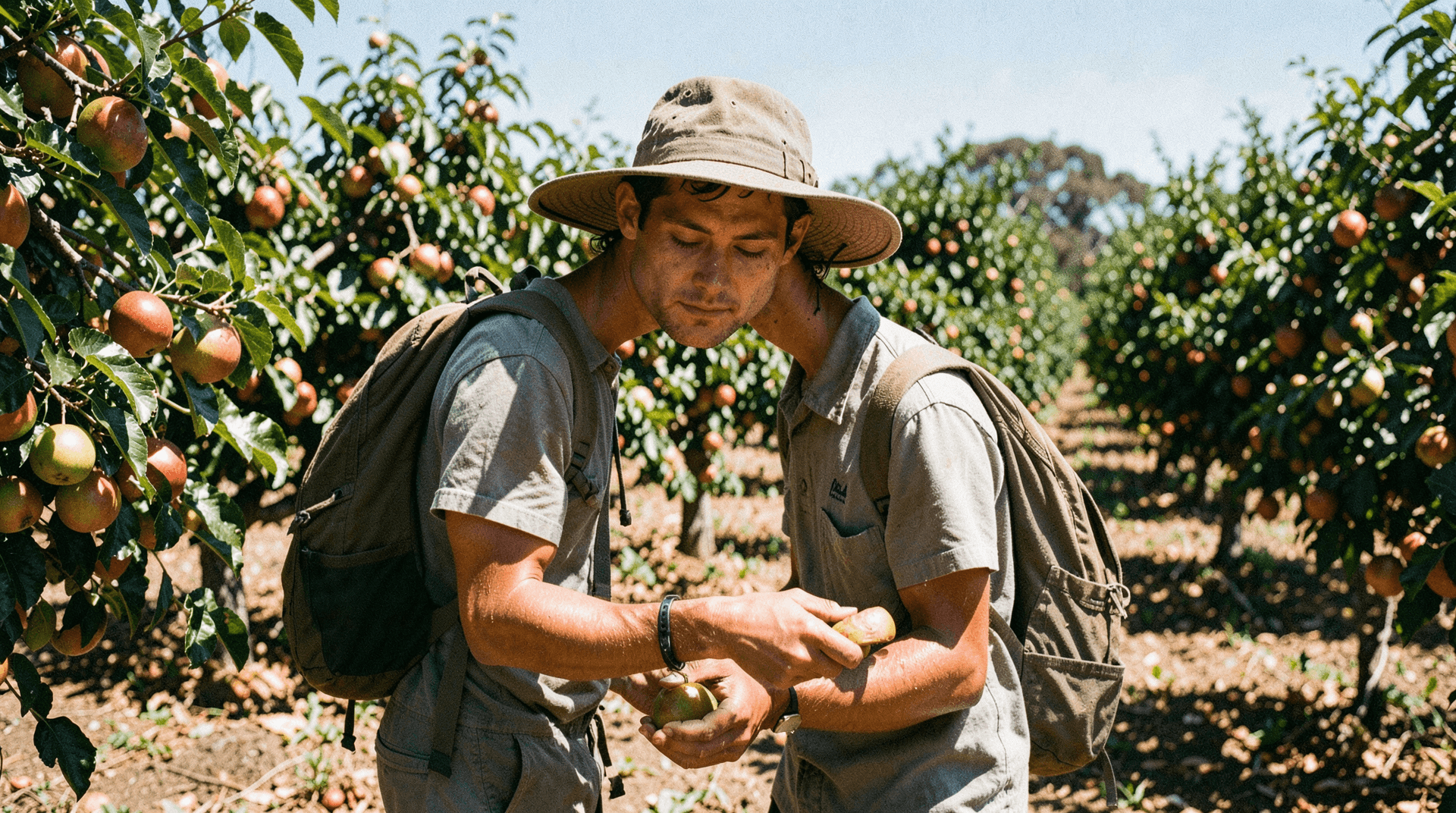
Fruit picking/farm work: The go-to for earning your second-year visa. Pay varies enormously — piece-rate work (paid per bin/bucket) can pay well if you're fast, or poorly if you're slow. Hourly rates must meet the minimum wage ($24.10/hour as of July 2025).
Construction: Well-paid work, especially in regional areas. A White Card (general construction induction) is required — costs about $70 and takes one day.
Retail and customer service: Easy to find in cities, especially around Christmas/holiday periods.
Au pair/nanny: Popular but make sure it's legitimate employment with proper wages and superannuation, not an exploitative arrangement.
Mining: The highest-paying option. FIFO (fly-in-fly-out) positions in Western Australia and Queensland can pay $80,000–$120,000+ per year.
Worker Exploitation Warning
Exploitation of working holiday makers is a persistent problem in Australia. The Fair Work Ombudsman actively investigates cases. Know your rights:
- Minimum wage: $24.10/hour (as of July 2025). No employer can legally pay less.
- Superannuation: Your employer must pay 11.5% super on top of your wages.
- Tax: You'll be taxed at 15% on the first $45,000 earned (special WHM tax rate).
- Payslips: Every employer must provide payslips within 1 business day of payment.
If an employer demands cash payments, refuses to provide payslips, or threatens your visa status if you complain, they're breaking the law. Report them to the Fair Work Ombudsman — your visa won't be affected by reporting exploitation.
Some farms and labour hire companies are notorious for underpaying backpackers, particularly in fruit picking. Research employers on the Harvest Trail website and online forums before committing.
Tax and Superannuation
Working holiday makers have a special tax arrangement.
Tax rate: 15% on the first $45,000 earned, then normal marginal rates above that. You don't get the tax-free threshold that Australian residents receive.
Tax File Number (TFN): Apply online through the ATO website as soon as you arrive. Without a TFN, your employer must withhold tax at the highest rate (45%).
Superannuation refund: When you leave Australia permanently, you can claim your accumulated superannuation (retirement savings) as a Departing Australia Superannuation Payment (DASP). The refund is taxed at 65%, so you won't get it all back, but it's better than leaving it in a fund you can't access.
Frequently Asked Questions
Can I bring my partner on a 417 visa?
No. The 417 doesn't allow you to include a partner or dependent children. Your partner would need to apply for their own visa independently — either their own 417 (if eligible) or another visa type. De facto partners cannot be added to this visa.
What's the 6-month employer rule?
You cannot work for the same employer for more than 6 months unless you receive permission from the Department of Home Affairs. Exemptions are sometimes granted for work in northern Australia or specified work in regional areas. The penalty for breaching this condition can include visa cancellation.
Can I apply for a 417 if I've already had one?
Yes — you can hold up to three 417 visas in your lifetime (first year, second year, third year). But you can't apply for a first-year 417 if you've already held one. The second and third visas are separate applications, each requiring proof of specified work.
Is fruit picking the only way to get a second-year visa?
No. Specified work includes farming, mining, construction, fishing, forestry, and bushfire/flood recovery work in regional areas. Fruit picking is the most accessible option, but construction and mining often pay significantly more. Any of these count equally toward your 88-day requirement.
Can I switch to a student visa or skilled visa from a 417?
Yes. You can apply for most other visas while on a 417. Many working holiday makers transition to a Student Visa (Subclass 500) to extend their stay, or to an employer-sponsored visa (482) if they find a sponsoring employer. You apply onshore through ImmiAccount.